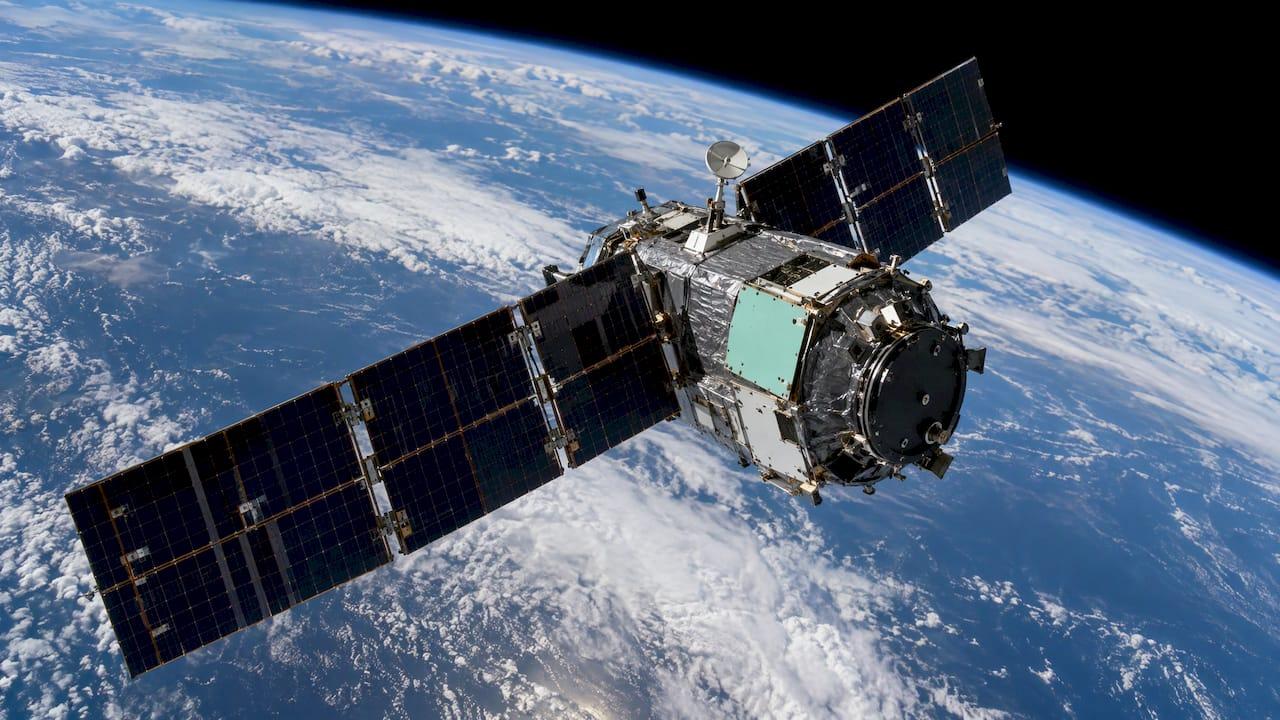
Orbital mechanics is the study of how objects move around other objects under gravity. The short version: an orbit is a fall that never ends. Something is always falling toward a planet or star, but it is also moving sideways fast enough to keep missing it.
That one idea explains moons, satellites, planets and comets. Below, we build it up step by step, with the few equations worth knowing and what they mean in plain words.
TL;DR
- An orbit is a balance between gravity pulling an object in and sideways motion carrying it past.
- Orbits are ellipses. A circle is just the special case with zero eccentricity.
- Objects move fastest at the closest point and slowest at the farthest point.
- Orbital period depends on the size of the orbit, not on its shape.
- Games simplify all of this, and you can feel the real ideas by playing with them.
Table of Contents
- What orbital mechanics is
- Why an orbit is a fall that misses
- How gravity weakens with distance
- Orbits are ellipses
- Closest point, farthest point
- How long an orbit takes
- Escape velocity
- Changing an orbit
- Two bodies, one center
- How games simplify orbital mechanics
- Try it yourself
- FAQ
- Sources
What orbital mechanics is
The field is also called astrodynamics. It applies ballistics and celestial mechanics to rockets, satellites and other spacecraft. NASA's Jet Propulsion Laboratory describes it as a modern treatment of celestial mechanics that includes artificial satellites moving under gravity, thrust, drag and solar wind. Its uses include launch ascent, reentry, rendezvous, and lunar and planetary trajectories.
You do not need calculus to follow the core. You need three things: gravity, motion and a bit of geometry.
Why an orbit is a fall that misses
Picture throwing a ball off a very tall tower. Throw it gently and it lands close by. Throw it harder and it lands farther away. Throw it hard enough and the ground curves away beneath it as fast as it falls. ESA uses this same picture: a satellite is lifted above the thick atmosphere and then given a push by the rocket's engines, much like that throw.
NASA Space Place puts it this way: the object is always falling toward the planet but moves sideways fast enough that it never hits it. Without gravity, a satellite would fly off in a straight line, because an object in motion stays in motion unless something pushes or pulls on it. That is Newton's first law.
Too slow, too fast, just right
The American Museum of Natural History explains the three outcomes. If the object moves too slowly it spirals inward and falls. If it moves too fast it sails off into space. In between, it stays in orbit.
NASA JPL Education describes the same thing as a gravity well. An object could impact, enter orbit, or pass by and leave, depending on its speed. Spacecraft need progressively higher speeds to enter Earth orbit, leave Earth's well and leave the Sun's.

How gravity weakens with distance
Gravity gets stronger with the masses involved and weaker with distance. The Open University states that the force is proportional to the product of the masses and falls with the square of the distance between their centres. Triple the distance and the pull drops by a factor of nine.
This is why a far-off moon feels a gentle tug and a close one feels a strong one. It is also why close orbits are fast and distant orbits are slow.
Orbits are ellipses
Johannes Kepler found that planets do not travel in perfect circles. NASA lists his three laws:
- Every planet's orbit is an ellipse with the Sun at one focus.
- A line from planet to Sun sweeps out equal areas in equal times.
- The square of the orbital period is proportional to the cube of the semi-major axis.
An ellipse is a closed curve where the distances to two fixed points, the foci, always add up to the same number. The body being orbited sits at one focus, not at the center.
Circles, ellipses and eccentricity
Eccentricity measures how stretched an ellipse is. NASA defines it as the distance between the foci divided by the major axis. If the foci coincide, you have a circle, with eccentricity zero.
ESA describes the scale: zero for perfectly circular, approaching but always below one for very elongated orbits. In a round orbit a satellite stays the same distance away. In an eccentric one it swings closer and farther.
Circles are not the norm. The National Radio Astronomy Observatory notes that a circular orbit is a special case of an elliptical orbit. Ellipses allow a wider range of starting conditions, so they are the more likely outcome when a planetary system forms.
| Eccentricity | Path | Bound? |
|---|---|---|
| 0 | Circle | Yes |
| Between 0 and 1 | Ellipse | Yes |
| Exactly 1 | Parabola | No |
| Above 1 | Hyperbola | No |
The last two rows follow the standard classification of bound and unbound paths. A parabola or hyperbola means the object passes by once and leaves.
Closest point, farthest point
Every elliptical orbit has a closest and a farthest point. The closest point is the periapsis and the farthest is the apoapsis. Names change with the host: perihelion and aphelion for the Sun, perigee and apogee for Earth, as Braeunig's primer lays out.
Speed changes along the way. The object moves fastest at periapsis and slowest at apoapsis. Kepler's second law explains why: angular momentum is conserved, so the object speeds up as it falls closer and slows as it climbs away.
In a circular orbit there is no periapsis or apoapsis, because every point is the same distance from the center.
Earth is almost circular
Earth's eccentricity is only about 0.0167. That gives a roughly 3.4% swing in Sun distance, from about 147 million km in early January to about 152 million km in early July, according to this orbital eccentricity summary. Seasons come from axial tilt, not from this small change.
How long an orbit takes
Kepler's third law gives the period: T = 2π√(a³/GM), where a is the semi-major axis and M the mass of the central body. A striking result is that all ellipses with the same semi-major axis share the same period, whatever their eccentricity.
Some examples: a low Earth orbit satellite circles Earth in roughly 90 minutes. A geostationary satellite takes about one sidereal day. Earth takes about a year to circle the Sun because its semi-major axis is about 1 astronomical unit.
Altitude matters. NASA gives Vanguard-1 as an example: periapsis altitude 654 km, apoapsis altitude 3,969 km, and a period of 134.2 minutes.

Speed at any point
The vis-viva equation gives speed anywhere on an orbit: v = √(GM(2/r − 1/a)). Here r is your current distance and a is the semi-major axis. For a circular orbit the speed is constant and equals √(GM/r), as the orbital period reference states.
Escape velocity
Escape velocity is the minimum speed needed to leave a gravity field for good: √(2GM/r). It is exactly √2 times the circular orbital speed at the same distance. For Earth's surface it is about 11.2 km/s.
It does not depend on the direction of launch or on the mass of the escaping object. Georgia Tech's physics text describes the boundary: if sideways speed is too high the object reaches escape velocity and travels outward, and if too low it falls inward.
Changing an orbit
Once a rocket motor shuts off, a satellite keeps its speed and gravity bends its path. The Institute of Physics notes that in empty space it would orbit forever, but low Earth orbit satellites meet drag from the thin atmosphere and need occasional rocket thrusts.
Burns work in a way that surprises beginners. NASA explains that a spacecraft's periapsis altitude can be raised by firing thrusters at apoapsis. Speeding up at one point changes the opposite side of the orbit.
Two bodies, one center
Orbits are not really around the bigger object's center. ESA says objects of similar mass orbit each other with neither at the center, while small ones orbit large ones. NASA JPL adds that Earth and Moon circle a shared center of mass, which sits inside Earth, so it is simpler to say the Moon orbits Earth.
How games simplify orbital mechanics
Games bend the rules to stay playable. Kerbal Space Program uses a patched conic approximation. Gravity sources switch as a ship nears another body, so only one body pulls at a time. That makes the simulation stable and predictable, though it cannot model Lagrange points.
University of Alaska Fairbanks students point out another side effect: a ship in a chosen orbit can stay there indefinitely, free of the disturbances real orbits suffer. In-game bodies are also much smaller than real ones.
WIRED's Rhett Allain notes another shortcut. In some games, thrusting along your path speeds you up at the same radius, and thrusting sideways changes radius but not speed. It is easier to steer, but not real physics.
These simplifications are fine for learning. They let you feel the core ideas first: speed beats distance, closer means faster, and gravity always wins eventually.
Our view
We think the best way to learn orbits is to play with them. Reading that closer means faster is one thing. Watching a tiny rock swing past a planet and get yanked into a new path is another.
That is why we built Anti-Horizon around gravity. You start as a small asteroid and use gravity to capture smaller bodies. As you grow through 22 classes, you meet real astronomy ideas in a simplified form. We do not claim it replaces a textbook. We do think it gives the textbook something to hold on to.
There are no ads in the game itself and no in-game purchases. You can just drift in and try things.
Anti
Try it yourself
Want to see gravity at work without any math? Anti-Horizon is a free browser game where you begin as an asteroid and grow into a galaxy-scale black hole by capturing smaller bodies with gravity. It has multiplayer arenas, daily challenges, survival runs, boss gauntlets, salvage expeditions and a sandbox. It runs in the browser and on PC and Mac with no install.

The sandbox is a calm place to poke at ideas from this article. Pass a body slowly, then quickly, and see what changes.
FAQ
Is orbital mechanics hard to learn?
The ideas are not. Gravity pulls, sideways speed carries, and the mix makes an orbit. The hard part is the math for precise paths. Start with the concepts here, then add Kepler's laws and the vis-viva equation.
Why are orbits ellipses instead of circles?
A circle needs one exact speed at one exact distance. Ellipses allow a much wider range of starting conditions, so they are the more probable outcome. A circle is simply an ellipse with eccentricity zero.
Why do satellites not fall down?
They do fall, constantly. They also move sideways fast enough that the planet's surface curves away beneath them. That is why the balance of momentum and gravity keeps them up.
What happens if an object goes too fast?
It reaches escape velocity and leaves. At Earth's surface that is about 11.2 km/s, and it is exactly √2 times the circular orbital speed at the same distance.
Sources
- Orbital mechanics (Wikipedia)
- NASA JPL, Chapter 7: Orbital Mechanics
- ESA, Types of orbits
- NASA Space Place, What Is an Orbit?
- American Museum of Natural History, Gravity Concepts
- NASA JPL, Modeling the Orbits of Planets
- Open University, Orbits and gravity
- NASA Science, Gravity & Mechanics (Kepler's laws)
- NASA Science, Gravity & Mechanics (ellipses)
- NASA Science, Gravity & Mechanics (orbit changes)
- NRAO, Why is Earth's orbit elliptical?
- Orbital eccentricity
- Braeunig, Basics of Space Flight: Orbital Mechanics
- Orbital period (Wikipedia)
- Orbital Period Calculator
- Albert, Satellite Orbits review
- Georgia Tech Physics Book, Perpetual Freefall
- IOPSpark, How do things stay in orbit?
- PC Gamer, Recreating gravity in games
- University of Alaska Fairbanks, Physics of Kerbal Space Program
- WIRED, Modeling orbital motion in a game