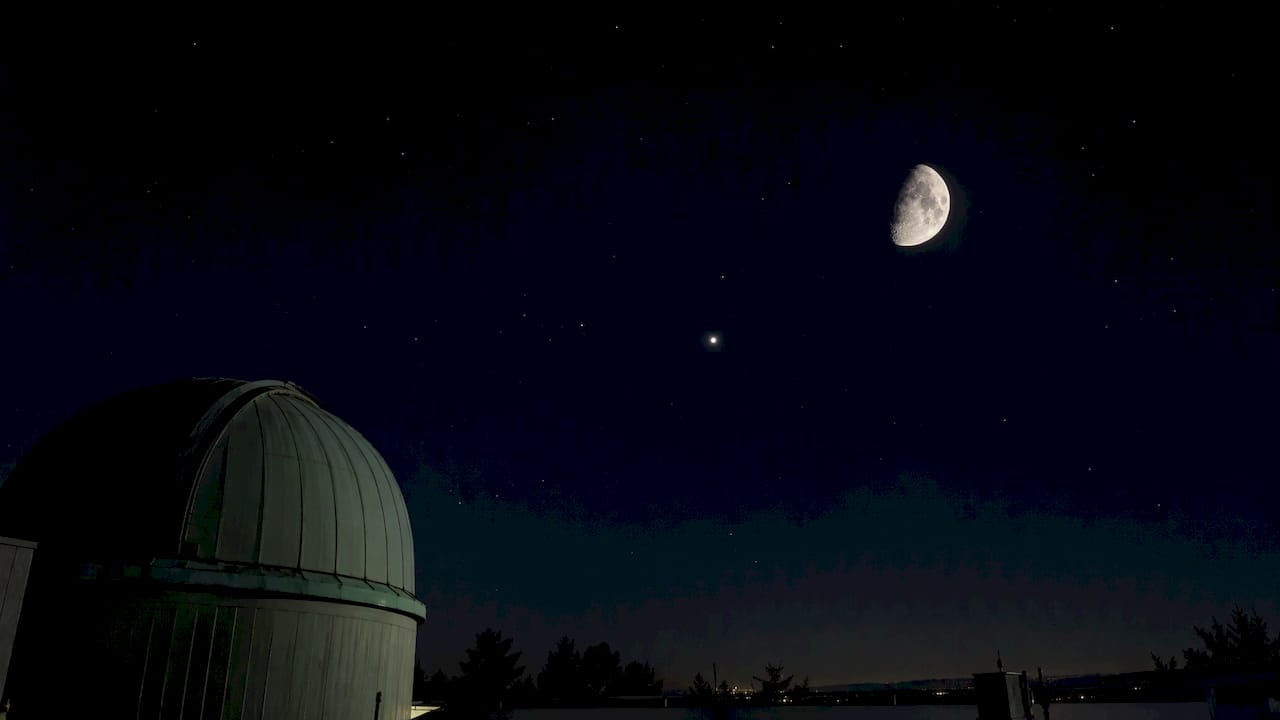
Celestial bodies are the physical things out in space that astronomers study. The main types are stars, planets, dwarf planets, moons, asteroids, comets and galaxies. Past our Solar System you also find exoplanets, white dwarfs, neutron stars and black holes.
That is the short list. The long one is more fun. Let's drift through it, one type at a time, with real examples and a few honest notes about where the labels get blurry.
TL;DR
- A celestial body is a broad term for objects in space, such as stars, planets and galaxies.
- Inside our Solar System, the big groups are the Sun, planets, dwarf planets, moons, asteroids and comets.
- Beyond it, think exoplanets, star clusters, black holes and whole galaxies.
- Yes, planets count as celestial bodies. So do moons, comets and dwarf planets.
- Edges are fuzzy. Some objects fit more than one category.
Table of Contents
- What counts as a celestial body
- Stars
- Planets
- Dwarf planets
- Moons
- Asteroids, comets and meteoroids
- Galaxies and larger structures
- Examples beyond our Solar System
- Quick comparison table
- How astronomers tell types apart
- Our perspective
- Try the types for yourself
- A simple way to remember it all
- FAQ
- Sources
What counts as a celestial body
The phrase sounds formal. The idea is simple. A celestial body is a physical thing in space. Astro4Edu's glossary uses it as a broad term for the entities astronomers study, including stars, planets and galaxies.
Some astronomers use a tighter meaning. For them, a celestial body is a clearly separate, tightly bound object. Under that stricter view, a gas cloud is not quite a body. A galaxy is a bit too big and loose to qualify.
In everyday talk, people mix the terms. "Celestial body," "celestial object" and "astronomical object" often mean the same thing. This guide uses the friendly, broad meaning. Where the strict meaning matters, we say so.
A quick map helps. Think in layers:
- Small things: dust, meteoroids, asteroids and comets.
- Round worlds: dwarf planets, moons and planets.
- Stars and the systems around them.
- Giant structures: star clusters, galaxies and galaxy clusters.
Each layer sits inside the next one. Planets circle stars. Stars gather into galaxies. Galaxies gather into clusters.
Stars
Stars are glowing balls of gas. Inside them, nuclear fusion makes energy. The Sun is a star, and it is the one that matters most to us.
Stars make their own light and heat. That is the big difference from planets and moons. Those only shine by reflecting light from a star.
Stars come in many sizes and life stages. Some stars end up as white dwarfs. Others become neutron stars, including pulsars, and some leave behind black holes. These end states are listed as separate classes in astronomy catalogs. Sirius A, a bright star, and its small companion, the white dwarf Sirius B, show two stages side by side.
If you want one sentence: a star is a self-powered ball of gas, and everything else on this page either orbits one or is made of many.
Planets
Planets are the celestial bodies most people picture first. They are moderately large objects that orbit a star. They reflect light from their star and are generally rocky or gaseous and round.
What makes a planet a planet
In 2006, the International Astronomical Union (IAU) set the rules for our Solar System. A planet must do three things, according to NASA's explanation:
- Orbit the Sun.
- Be massive enough that its own gravity pulls it into a nearly round shape.
- Be gravitationally dominant enough to clear its orbital neighborhood.
That last rule is the tricky one. It means the planet is the main thing in its lane.
By that definition, the Solar System has eight planets: Mercury, Venus, Earth, Mars, Jupiter, Saturn, Uranus and Neptune.
Rocky planets and gas giants
The eight split into two families. NASA describes Mercury, Venus, Earth and Mars as rocky terrestrial planets. Jupiter, Saturn, Uranus and Neptune are gas giants. They are largely hydrogen and helium, with small solid cores.

So the inner four are small and solid. The outer four are huge and gassy. Easy to remember, and it covers every planet we have.
Planets around other stars
Planets also orbit stars other than the Sun. These are called exoplanets, and astronomers list them as their own class of object. When someone asks about "planets beyond our solar system," this is the answer.
Dwarf planets
A dwarf planet orbits the Sun and is round thanks to its own gravity. The catch: it has not cleared its orbital path. The IAU definition is summarized on NASA's StarChild page, which lists Pluto, Ceres, Eris, Haumea and Makemake as examples.
Pluto is the famous one. It was once counted as the ninth planet. After the 2006 definition, it moved into the dwarf planet group. Nothing about Pluto itself changed. Only the label did.
This is a good reminder. Categories are human tools. The objects just keep orbiting.
Moons
A moon is an object that orbits a planet. Astronomers also call these satellites. Earth's satellite is the Moon.
Moons are celestial bodies in their own right. They have their own surfaces, their own histories and their own pull. Many of them are worlds you could name and map.
Note the word "natural" here. Human-made satellites orbit planets too, but they are spacecraft, not celestial bodies.
Asteroids, comets and meteoroids
Now for the small stuff. This group is a favorite of ours, because it is where a tiny rock can start a big story.
Asteroids
Asteroids are rocky and airless. NASA's guide to space rocks sets them apart from comets by composition: asteroids are rocky, comets contain ice.
Comets
Comets orbit the Sun. Each has a nucleus made of icy chunks of frozen gases, plus bits of rock and dust. Near the Sun, a comet forms a coma and two tails. The solar wind pushes those tails away from the Sun.

That is why a comet's tail points away from the Sun, no matter which way the comet is traveling.
Meteoroids, meteors and meteorites
Three words, three stages. According to NASA:
- A meteoroid is a small fragment or piece of debris in space. Collisions involving asteroids, comets, moons or planets often produce them.
- A meteor is the visible streak of light in the atmosphere.
- A meteorite is material that reaches the ground.
So a shooting star is not a star at all. It is a small fragment burning up.
Small Solar System bodies
Astronomers also use one umbrella label for the leftovers. Small Solar System Bodies are objects that orbit the Sun and are neither planets, dwarf planets nor satellites. Japan's National Astronomical Observatory lists asteroids, most trans-Neptunian objects, comets and other small bodies in that group.
Galaxies and larger structures
A galaxy is a gravitationally bound group of stars, planets, moons, gas, dust and other objects. NASA's glossary gives the Milky Way as the example. That is our home galaxy.
Going bigger, textbook overviews describe stars and planets, stellar systems, galaxies, galactic clusters and superclusters. It is a ladder of structures, each built from the one below.
Are galaxies and nebulae "bodies"?
It depends on who you ask. Under the strict meaning, a celestial body is a compact, clearly separate object. Gas clouds and galaxies are structurally different from that. Under the broad, everyday meaning, they count.
For most readers, the safe move is simple. Call galaxies and nebulae "astronomical objects" or "celestial objects." Call planets, moons, stars and asteroids "celestial bodies." You will be understood either way.
Examples beyond our Solar System
The sky does not stop at Neptune. Catalogs of astronomical objects include these examples outside the Solar System:
- Exoplanets, which are planets around other stars.
- Sirius A, a star, and Sirius B, a white dwarf.
- Vela Pulsar, a pulsar.
- Sagittarius A*, a black hole.
- Star clusters and other galaxies.
Each one belongs to a different class. A pulsar is a kind of neutron star. A white dwarf is a star's leftover core. A black hole is a region where gravity wins completely.
Quick comparison table
| Type | What it is | Example |
|---|---|---|
| Star | Glowing ball of gas powered by fusion | The Sun |
| Planet | Orbits the Sun, nearly round, has cleared its orbit | Earth, Jupiter |
| Dwarf planet | Orbits the Sun, round, has not cleared its orbit | Pluto, Ceres |
| Moon | Orbits a planet | Earth's Moon |
| Asteroid | Rocky, airless body | Space rocks in the Solar System |
| Comet | Icy nucleus, with a coma and tails near the Sun | Any comet near the Sun |
| Galaxy | Gravitationally bound group of stars, gas, dust and more | The Milky Way |
| Black hole | End state of some stars, beyond the Solar System | Sagittarius A* |
How astronomers tell types apart
Astronomers sort objects by a few clear clues:
- Orbit. Does it circle a star, a planet or the center of a galaxy?
- Size and shape. Is it massive enough to be pulled round by its own gravity?
- Composition. Is it rock, ice, gas or plasma?
- Activity. Does it glow, make a tail or shine only by reflection?
The IAU framework for planets rests on three of these: orbit, self-gravity and whether the neighborhood is cleared.
When the labels blur
Nature does not always follow our boxes. A teacher guide from the Lawrence Hall of Science notes that some objects do not fit a category neatly, and some straddle two categories. It even points to a possible continuum running from terrestrial planets through asteroids to comets.
That is not a flaw. It is how natural populations behave. Treat the types as helpful names, not rigid walls.
Our perspective
We built Anti-Horizon around this exact ladder of objects. You start as a tiny asteroid. You end as a galaxy-scale black hole. In between, you move through 22 classes.
Why this shape? Because the types of celestial bodies are not a list to memorize. They are a story of growth. Small things get pulled together by gravity. Bigger things pull harder. That simple loop is the heart of the game.
In Anti-Horizon, you capture smaller bodies with your gravity. Your mass grows. Your abilities grow. Rival worlds compete for the same resources, so every capture counts. The physics is simplified, but the principles come from real astronomy.
We think this is the friendliest way to learn what a dwarf planet or a star feels like. You do not read the difference. You play it. And because the game is free to play, with no in-game purchases, anyone curious can jump in.
Anti
Try the types for yourself
Reading about asteroids and black holes is one thing. Growing into one is another.
Anti-Horizon is a free browser game. You start as a tiny asteroid. You pull in smaller bodies with gravity and climb through 22 astronomical classes.

There is more than one way to play. Modes include multiplayer arenas, daily challenges, survival runs, boss gauntlets, salvage expeditions and a sandbox. The game runs in your browser, so there is nothing to install. There are no in-game purchases or subscriptions. Play Anti-Horizon and see how far past the horizon you can drift.
A simple way to remember it all
If the list feels long, use three questions:
- Does it make its own light? Then it is a star, or a structure made of stars.
- Does it orbit a star? Then it is a planet, dwarf planet, asteroid or comet.
- Does it orbit a planet? Then it is a moon.
Then check the details. Is it round? Rocky or icy? Has it cleared its path? Those answers pick the final label.
Here is a tiny worked example. Take Ceres. It orbits the Sun, so it is not a moon. It is round, but it has not cleared its path. That makes it a dwarf planet.
Now take a shooting star. It is not a star. It is a meteor, the streak made by a small fragment, a meteoroid, in the atmosphere. If a piece lands, it is a meteorite.
FAQ
Are planets considered celestial bodies?
Yes. The IAU definition quoted by NASA says a planet is a celestial body. It must orbit the Sun, be nearly round and clear its orbital neighborhood. Moons, dwarf planets, stars and comets count as well.
What is the difference between a celestial body and a celestial object?
In daily use, nothing much. People swap the words freely. In stricter use, a celestial body is a clearly separate, tightly bound thing, such as a planet. A celestial object is a wider label that also covers gas clouds and galaxies.
What are some examples of celestial bodies?
Inside the Solar System: the Sun, Earth, Jupiter, Pluto, the Moon, asteroids and comets. Outside it: exoplanets, white dwarfs, pulsars, black holes and other galaxies. Each fits one of the types above.
How is a dwarf planet different from a planet?
Both orbit the Sun and are round. A planet has also cleared its orbital path. A dwarf planet has not. That one rule is why Pluto, Ceres, Eris, Haumea and Makemake sit in the dwarf group.
Is a galaxy a celestial body?
In the broad sense, yes. A galaxy is a gravitationally bound group of stars, gas, dust and other objects, like the Milky Way. In the strict sense, it is a larger structure made of many bodies.
Sources
- Glossary term: Celestial Body (Astro4Edu)
- What is a Planet? (NASA Science)
- 10 Things: What's That Space Rock? (NASA Science)
- Basic Objects in the Universe (LibreTexts)
- The Planets and Dwarf Planets (NASA StarChild)
- The Solar System (NASA Science)
- Planet definition (National Astronomical Observatory of Japan)
- Glossary (NASA Space Place)
- Teacher Guide, Activities 88, 89 and 90 (Lawrence Hall of Science)
- Lists of astronomical objects (Wikipedia)